

Domaine Tissot
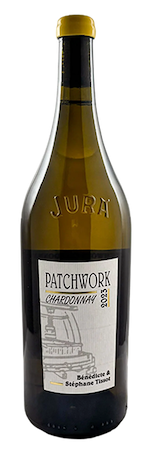
2023 Arbois AOC Patchwork Chardonnay
“Aromas strongly suggest tart lemon zest, toasted coconut, roasted almonds, sour green olives, cardamom, yellow flowers and sweet marzipan. Suspend all expectations of “Chardonnay-ness.” The startling bouquet of tropical, spicy and savory tones — as well as the interplay of zestiness and creaminess on the palate — makes this is a multidimensional wine. The joyride of acidity from this wine is like a rollercoaster, it twists and turns with each sip, and leaves you salivating for another sip on the finish.” - Kevin Day


Region: Arbois, Jura
Appellation: Arbois AOC
Varietal/Blend: 100% Chardonnay
ABV: 12.5%
Vineyard & Vine Age: Domaine Tissot Patchwork Chardonnay comes from biodynamic vineyards at 250–450 meters altitude. The 25-year-old vines, planted with selection massale, grow across a patchwork of Tissot’s limestone and clay terroirs, reflecting the cool continental climate’s influence on the wine’s style.
Cellar: Domaine Tissot Patchwork Chardonnay is spontaneously fermented with indigenous yeast. This vegan wine is aged 12 months in oak, with 10% new barrels, and bottled unfined and unfiltered, to preserve purity and express its limestone and clay terroir.
CSPC: 845928
What the Critics are saying: "The 2023 Patchwork Chardonnay was produced with grapes from clay (60%) and limestone (40%) soils and aged in barrel for one year. 2023 was also warm, but the wine is fresher than the 2022, partially because of the good yields that produced fine-boned musts. The idea is to show the Jura, which is a blend of terroirs, in a white that is tasty, balanced and with a sense of ripe fruit. Fermentation of Chardonnay is increasingly difficult in warm vintages like 2022 and 2023, while Savagnin has easier fermentations. 33,000 bottles produced." 92+/100. Luis Gutiérrez, Robert Parker's Wine Advocate, Sep 11 2025

Region: Arbois, Jura
Appellation: Arbois AOC

“Aromas strongly suggest tart lemon zest, toasted coconut, roasted almonds, sour green olives, cardamom, yellow flowers and sweet marzipan. Suspend all expectations of “Chardonnay-ness.” The startling bouquet of tropical, spicy and savory tones — as well as the interplay of zestiness and creaminess on the palate — makes this is a multidimensional wine. The joyride of acidity from this wine is like a rollercoaster, it twists and turns with each sip, and leaves you salivating for another sip on the finish.” - Kevin Day
TECHNICAL INFO
Varietal/Blend: 100% Chardonnay
ABV: 12.5%
Vineyard: Domaine Tissot Patchwork Chardonnay comes from biodynamic vineyards at 250–450 meters altitude. The 25-year-old vines, planted with selection massale, grow across a patchwork of Tissot’s limestone and clay terroirs, reflecting the cool continental climate’s influence on the wine’s style.
Cellar: Domaine Tissot Patchwork Chardonnay is spontaneously fermented with indigenous yeast. This vegan wine is aged 12 months in oak, with 10% new barrels, and bottled unfined and unfiltered, to preserve purity and express its limestone and clay terroir.
CSPC: 845928
What the Critics are saying: "The 2023 Patchwork Chardonnay was produced with grapes from clay (60%) and limestone (40%) soils and aged in barrel for one year. 2023 was also warm, but the wine is fresher than the 2022, partially because of the good yields that produced fine-boned musts. The idea is to show the Jura, which is a blend of terroirs, in a white that is tasty, balanced and with a sense of ripe fruit. Fermentation of Chardonnay is increasingly difficult in warm vintages like 2022 and 2023, while Savagnin has easier fermentations. 33,000 bottles produced." 92+/100. Luis Gutiérrez, Robert Parker's Wine Advocate, Sep 11 2025
Giovanni Autuori
Calgary + Alberta South
T: 403-971-1898
E: giovanni@vinoalvino.ca
Joe Gurba
Edmonton + Alberta North
T: 780-203-5284
E: joeg@vinoalvino.ca